
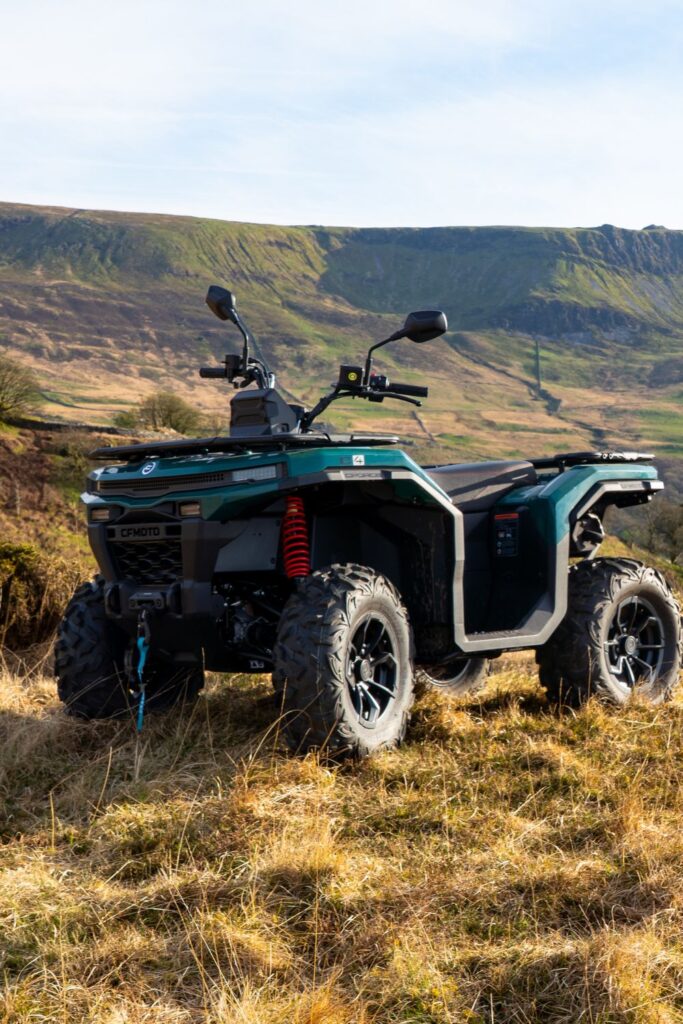
We can all see that the new CFMOTO C-platform has had a complete cosmetic makeover. The new C4 and C5 look sharper, more modern and considerably different from the previous generation CFORCE 450 & CFORCE 520 that they have replaced.
However, what has changed under the surface is a lot more significant than that.
CFMOTO hasn’t simply redesigned the plastics, fitted a larger display and given the machines a new name. The C4 and C5 introduce a new frame design, revised engines, increased power, greater carrying capacity, improved ground clearance, updated suspension and electrical systems, and longer service intervals.
So, let’s look beyond the new styling and see what’s actually changed.
A Completely Redesigned Frame
One of the biggest changes isn’t something you’ll immediately see when looking at the finished machine: the chassis itself.
The previous CFORCE 450 & CFORCE 520 frame was constructed using 20CrMo chromium-molybdenum alloy steel.
For the new C-platform, CFMOTO has taken a different approach. Instead of specifying the same material throughout the structure, the C4 and C5 chassis uses three different materials in different areas:
- HC500-780DT
- 20CrMoTi
- 20CrMo
CFMOTO describes its approach as “Lightweight + Local Reinforcement.”
In other words, rather than simply making everything heavier in pursuit of strength, different materials are being used in different sections of the chassis according to their job.
The main frame structure uses HC500-780DT high-strength steel, while 20CrMo and 20CrMoTi are retained in selected areas of the chassis.
For us, this is one of the clearest indications that the C-platform isn’t simply a previous model CFORCE in new clothes. CFMOTO has gone all the way back to revisit the structure underneath it.
More Power from Both C4 and C5
It’s not just the frame. The engines have received attention too.
CFMOTO’s previous figures of 31 hp and 36.7 hp have increased to 32.8 hp and 38.8 hp respectively on the new platform.
The C4 uses a 408.8cc liquid-cooled single-cylinder engine producing:
32.8 hp at 7,750 rpm
34.5 Nm at 5,500 rpm
The C5 steps up to a 499cc liquid-cooled single-cylinder engine producing:
38.8 hp at 7,500 rpm
43.5 Nm at 5,500 rpm
These aren’t enormous headline-grabbing power increases, and that’s perhaps the point. The C-platform appears to be about improving the complete machine rather than chasing one impressive specification.
But It’s the Engine Layout That’s Really Interesting
The power figures only tell part of the story.
One of the cleverest changes CFMOTO has made with the new C-platform is the orientation of the engine itself.
The new engine layout has effectively been turned around, placing the intake towards the front of the machine and allowing the exhaust to exit towards the rear.
That might sound like a fairly insignificant engineering change, but it solves a couple of very real problems.
On a conventional ATV layout, the exhaust system has to find its way from the engine towards the rear of the machine. That means routing a very hot exhaust through an already tightly packaged area close to the rider.
Turn the engine around and suddenly the exhaust has a much more direct route out of the back.
The result is less exhaust pipe running through the centre of the ATV and therefore less heat being transferred into the area around the rider’s legs.
CFMOTO says the new arrangement reduces the average perceived temperature around the rider’s legs by around 5°C.
Anyone who has spent a summer’s day working an ATV at relatively low speeds will understand why that matters. It’s not necessarily something you’ll appreciate during a five-minute test ride, but after several hours on the machine it could make a considerable difference.
A Narrower ATV Where It Matters
Turning the engine around has also helped CFMOTO tackle another important part of ATV ergonomics: the width between your legs.
It’s easy to look at the overall width of two ATVs on a specification sheet and assume they’ll feel roughly the same to ride.
They won’t necessarily.
The width that the rider actually feels is the centre section of the machine – where your knees and legs naturally grip the ATV.
The packaging of the new engine has allowed CFMOTO to make this area considerably narrower, with CFMOTO stating that the new C-platform has a one-third narrower leg-grip area than the previous generation.
That’s a substantial difference.
A narrower centre section allows the rider to grip the machine more naturally with their legs and makes it easier to move your body around when riding over uneven terrain.
For agricultural and utility users who may spend hours at a time on their ATV, those seemingly small ergonomic changes can be every bit as important as an increase in horsepower.
Smaller Grips, Bigger Difference
CFMOTO has continued the same thinking at the handlebars.
The new C-platform uses narrower 23mm handlebar grips, designed to reduce the amount of effort required to maintain a comfortable grip on the bars.
Again, 23mm isn’t the sort of number that’s going to sell an ATV from a specification sheet.
But put the changes together – a narrower centre section, smaller grips and revised rider controls – and you start to see that CFMOTO has spent quite a lot of time looking at the points where the rider actually interacts with the machine.
The seat has received attention too, with 8.2mm of additional cushioning compared with the previous generation.
None of these changes individually transforms an ATV.
Collectively, however, they should make the C4 and C5 noticeably more comfortable machines to spend a working day on.
Less Vibration Through the New Engine
There’s another significant change hidden inside the new engine.
The C4 and C5 use a dual balance shaft arrangement, with the crankshaft directly driving both left and right balance shafts.
A large single-cylinder ATV engine will naturally generate vibration as the piston and internal components rapidly change direction. Balance shafts are designed to counteract some of those forces before that vibration reaches the chassis, handlebars, footrests and ultimately the rider.
Using twin balance shafts is therefore another example of CFMOTO concentrating on refinement rather than simply extracting more horsepower from the engine.
Combined with the narrower riding position, revised grips, additional seat cushioning and reduced exhaust heat, it becomes clear that rider comfort has been a significant part of the C-platform redesign.
More Ground Clearance
Of course, comfort doesn’t matter much if a working ATV can’t get where it needs to go.
Ground clearance has increased from 250mm on the previous generation to 260mm or 273mm, depending on whether the machine is fitted with 24-inch or 25-inch tyres.
An additional 10 or 23mm might not sound dramatic, but underneath an ATV it can be the difference between clearing an obstacle and catching the underside of the machine.
For customers crossing rutted fields, woodland tracks, gateways and rough terrain on a daily basis, it’s another useful improvement rather than simply another number for the brochure.
Increased Carrying Capacity
The racks have become more capable too.
The previous generation’s 30kg front and 60kg rear rack capacities have increased to 40kg at the front and 80kg at the rear.
That’s an increase from 90kg to 120kg of combined rack capacity.
For an ATV that’s going to spend its life carrying fencing equipment, tools, feed or other equipment around a farm or estate, an extra 30kg of usable rack capacity is arguably far more valuable than a few additional horsepower.
The C-platform also retains serious towing capability, with the UK-specification technical information listing a 620kg towing capacity.
Suspension Designed for Work and Play
Both the C4 and C5 use double A-arm independent suspension front and rear, with 200mm of total wheel travel at the front and 227mm at the rear.
The coil-spring hydraulic shock absorbers also provide adjustable preload.
That adjustment is particularly useful on a working ATV because the suspension can be set appropriately when regularly carrying additional weight.
It’s another area where the changes to the C-platform need to be looked at together.
CFMOTO has increased carrying capacity and ground clearance while also revisiting the frame, suspension and overall packaging of the machine.
A Much Bigger 5.9-Inch Display
Then we get to one of the changes you definitely won’t have to look underneath the bodywork to find.
The previous 3.5-inch display has been replaced by a 5.9-inch LCD instrument cluster.
It’s a significant increase in screen size and immediately makes the cockpit feel like it belongs to a newer generation of machine.
But the changes to the electronics go deeper than the display.
The C-platform uses CANBUS communication between several of its electronic systems and provides OBD diagnostic access, allowing fault information to be read through diagnostic equipment.
That might not matter much when you’re riding it, but from a servicing and diagnostics perspective it’s another indication of how much the architecture of the machine has evolved.
Improved Starting and Cold-Weather Operation
There are even improvements buried deep within the electrical and engine systems.
CFMOTO has increased the starter motor circuit wiring from 12mm² to 16mm² and increased the power rating of the starter motor.
The engine also incorporates a decompression system that reduces cylinder pressure while the engine is being cranked, reducing the load placed on the starter motor. Once the engine starts, the decompression mechanism automatically disengages.
CFMOTO states that the minimum operating temperature has improved from -15°C to -25°C.
For a leisure machine, that might be relatively unimportant.
For an ATV expected to start on a cold winter morning and go to work, it’s a different story.
Longer Service Intervals
Finally, there’s another improvement that won’t necessarily get much attention in the showroom but could matter considerably during ownership.
The regular service interval has increased from 1,600km to 2,000km or 100 hours.
For machines covering substantial hours every year, longer intervals mean less downtime and fewer interruptions to the working schedule.
And that perhaps sums up what we find most interesting about the C-platform.
More Than a New Set of Plastics
There’s no question that the styling is what you’ll notice first.
Park a new C4 or C5 alongside the CFORCE 450 or 520 it replaces and the difference is immediately obvious.
But once you start looking underneath the bodywork, arguably the cosmetic redesign becomes the least interesting part of the story.
There’s a new multi-material frame. A completely different engine package. More power. Less heat around the rider. A narrower riding position. Twin balance shafts. Smaller grips. More seat cushioning. Increased rack capacity. More ground clearance. Revised suspension and electrical systems. Better cold-weather capability and longer service intervals.
Some are major engineering changes. Others are relatively small details.
But that’s what makes the C-platform interesting.
Rather than concentrating on one headline figure, CFMOTO appears to have gone through the previous generation machine system by system and asked where it could be improved.
The result isn’t simply a new-looking CFORCE 450 and 520.
Underneath the plastics, the CFORCE C4 and C5 really are a new generation of CFMOTO ATV.